Showing posts with label Local Food. Show all posts

Sunday, 13 March 2016

Rhubarb and Almond Tart - inspired by left-overs

I love rhubarb (I may have said this before!).  Its flavour, colour and sharp acidity that cuts through all the sweetness that we tend to surround it with.    Despite often treating it like a fruit by adding lots of sugar its a vegetable - the stem of the Rheum plant that joins the leaves to the stalk.

I think of rhubarb as a staple of british cooking, the basis of comfort food of my childhood - rhubarb and apple crumble with lots of custart (out of a packet of course).  But rhubarb wasn't recorded as a food crop in Europe until the 18th Century after Marco Polo brought it back from his adventures in south east asia where the roots were used in chinese medicine (particularly for its laxative properties....).  Even in the UK it was first grown as a medicine from seeds imported from Russia.  Its first recorded use as a food in britain was in  an1806-7 cookbook by Maria Eliza Rundell where it was used in a rhubarb tart.  My favourite uses for it also include a cinnamon and rhubarb tart where the filling is completed with double cream, a little flour and sugar, rhubarb polenta cake where the cornmeal soaks up the ruby red juices of the rhubarb and (of course) rhubarb and apple crumble.


When I couldn't resist the bright pink stems in the local farm shop one Saturday morning I wanted to do more with them than stew them and eat them with yoghurt and honey (although that's not a bad way to eat it either).  I had some sweet pastry and creme almond lurking in the freezer from before christmas which provided the inspiration for a rhubarb and almond tart.  Given it was completely made up I was really pleased with the outcome.  The sharpness of the Rhubarb cut through the sweetness of the almond paste and pastry, yet we could still taste all the different parts (and no soggy bottoms).
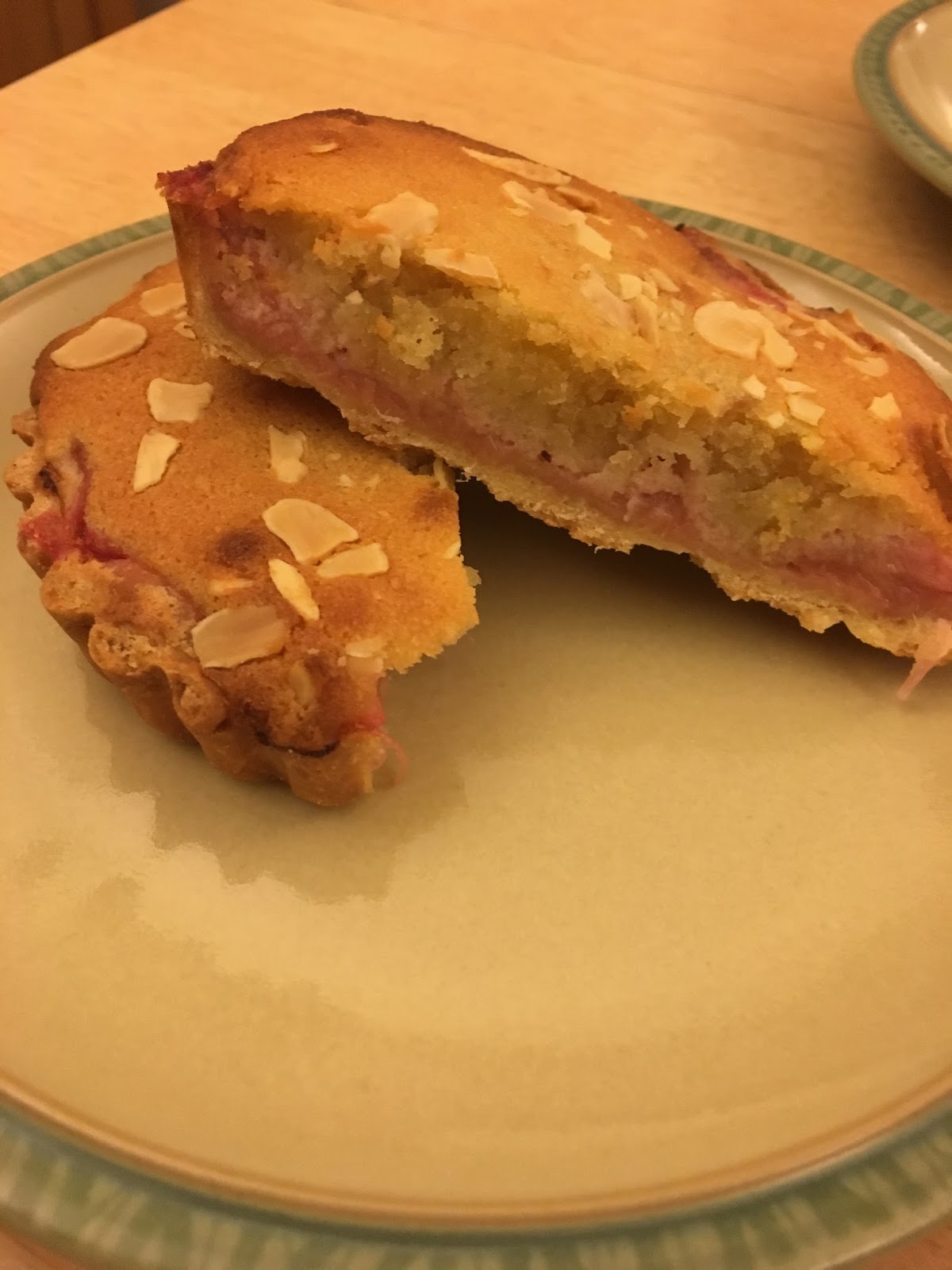


To make these line some small tart tins with the sweet pastry and blind bake them at 200 C to make sure they're  crisp.  As they came out of the oven remove the lining paper and baking  beans and brush with beaten egg and put them back in the oven for a couple for a couple of minutes.  Stew the ruhubarb and reduce down to a thick paste.  Add as little sugar as you can to make it palatable (the contrast between the sharpness of the rhubarb and sweetness of the almond paste is the joy of this tart) and put it in the bottom of the sweet pastry case.  Top with the almond paste and scatter with some flaked almonds.  Put the tarts back in the oven until the paste has set and browned on the top.  Cool on a wire rack before removing from the tins and dusting with a little icing sugar.

I'm always surprised and delighted when somehting I invent works and these were really good (even if I do say so myself).  Even Mr Vitty who isn't a great fan of either rhubarb or almond liked them.   When I make them again I'll use more rhubarb to get a deeper layer and try and make the rhubarb paste thicker so it doesn't leach quite so much into the almond layer.  Even so, if I bought these in a cafe to have with an afternoon cup of Earl Grey I wouldn't have been disappointed.



Tuesday, 26 January 2016

Norfolk Vinegar Cake

Vinegar isn't something I normally put in cakes but living in Norfolk I really wanted to try Norfolk Vinegar cake. Vinegar cakes were traditionally made when eggs were in short supply such as during the first world war.  They also keep well so were often sent to soldiers fighting in the trenches.

As well as the unusual addition of vinegar in Norfolk Vinegar cake it has an unusual ommission - eggs.  In most cakes eggs are essential for enabling the cake to rise.  Once you get rid of the shell, eggs comprise a protein rich white and a fat rich yolk. Normally when you mix fats (like oil) with water the fat forms a layer on top of the water.  Eggs contain a specific type of molecule called lipoprotein which enable the fats in cakes to mix with the watery elements like the milk.  When we make cakes we try and beat in a lot of air, whether that is during the creaming of sugar and butter or the addition of beaten egg white.  The structure of the pre-cooked cake mix is basically foam of very small bubbles.  As you cream together the butter and sugar the butter traps air on the surface of the sugar crystals.  The egg then helps these air bubbles retain their structure and mix in with the watery liquids.  When the cake is cooked the fat melts and the trapped air expands.  The egg protein combined with the flour stops the air completely escaping and the cake rises.

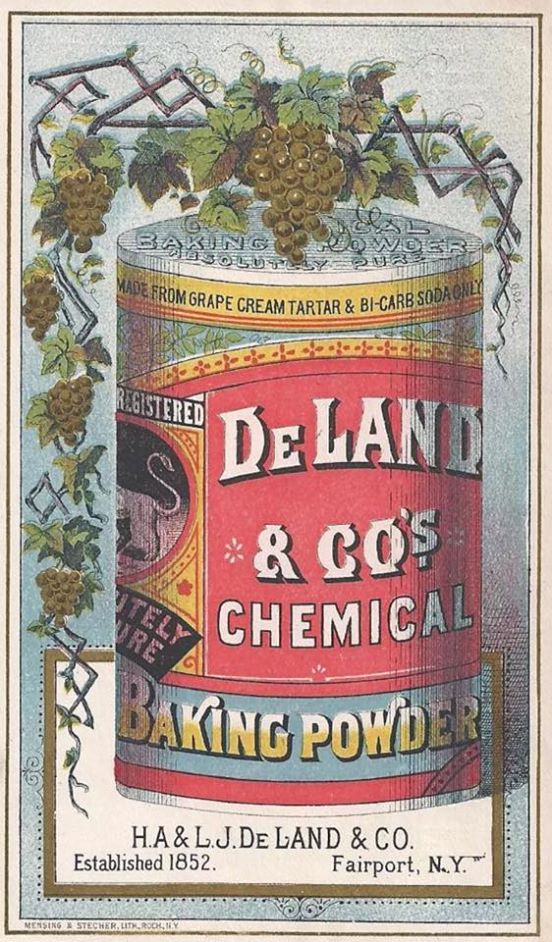
"Chemical Baking Powder" by Unknown - Collection of Lynn Purvis. Licensed under Public Domain via Commons - https://commons.wikimedia.org/wiki/File:Chemical_Baking_Powder.jpg#/media/File:Chemical_Baking_Powder.jpg
Until the the invention of baking powder eggs were the only thing that made cakes rise.  The active ingredients in baking powder are a mix of bicarbonate of soda and cream of tartar.  Cream of Tartar is an acid - potassium hydrogen tartarate (KC4H5O6). Bicarbonate of Soda is an alkali - Sodium Hydrogen Carbonate (NaHCO3).  When these two chemicals are mixed in a liquid there is a chemical reaction which produces carbon dioxide gas amongst other  things (NaHCO3 + KHC4H4O6 → KNaC4H4O6 + H2O + CO2). The carbon dioxide gas gets trapped in the cake mixture and as the cake is cooked the gas expands, making the cake rise.


Norfolk Vinegar cake rises using the same principle as baking powder.  The acidic vinegar in the cake replaces the acidic cream of tartar in baking powder and reacts with the bicarbonate of soda that is also in the ingredient list to produce the carbon dioxide that makes the cake rise.


Felt a bit odd adding vinegar to cake mix

Frothing of Vinegar + Bicarb=Carbon Dioxide

Mr Vitty was rather skeptical about the use of vinegar in cake, but the resulting cake was quite nice.  The texture of the cake mix was less runny than a normal cake mix and the final result was a cake with a texture similar to that of a rock cake.  It was also quite sweet - perhaps in an attempt to mask any residual vinegar taste.  If I make it again I think I'll add some grated apple to moisten it a little and some cinnamon, nutmeg or all spice to give it a bit of a more interesting flavour.  This could also be easily adapted to a dairy free vegan cake by replacing the milk with soy or almond milk and substituting the butter for a dairy free alternative.  Theoretically I guess you could substitute the vinegar for anything acidic - orange juice perhaps?  It's good for when you get that cake craving but can be bothered to go out and get eggs.


Ingredients:


225g Butter
450g Self Raising Flour
225g Caster Sugar
450g Dried Fruit
180ml Milk + 1 Tablespoon
2 Tablespoons Cider Vinegar
1 Teaspoon Bicarbonate of Soda

Method:


Rub the butter into the flour until it resembles breadcrumbs and then mix in the sugar and dried fruit.  In a large jug mix together 180ml of milk and the vinegar.  Mix the bicarbonate of soda with the remaining tablespoon of milk and add to the milk/vinegar mixture.  Mix the foaming milk into the dry ingredients and quickly place in a 23cm round baking tin.  Cook at 180 C for 30 minutes and then turn down the oven to 160 C continuing to cook for about an hour or until a knife placed into the cake comes out clean.

Saturday, 2 January 2016

New Year Food Resolutions

Its the time of year for making changes (or at least resolving to).  I'm terrible at keeping New Year Resolutions and therefore tend to make the same ones annually!  The annual food related resolutions are:

1. Shop more locally

2. Eat more seasonally

3. Diversify the meals we eat (we tend to get stuck in a rut)

 (and lose weight of course)


I live in rural Norfolk a region of the UK which is dependent on the agrifood industry for much of its economic growth.  The land I drive through every day on my way to work produces fruit, vegetables, poultry, pigs, dairy products (as well as vegetable oil, sugar and bootiful turkey).  Norfolk also as one of the longest coast lines in the country with the associated remnants of a fishing industry.  Good farm shops are around but it takes more effort to visit them than doing my weekly on-line sainsburys order.  Yet having vegetables grown in Peru which have been flown half way around the world so I can eat strawberries in December is bad for the planet and doesn't help me diversify the foods I eat.  I know I'll never be able to only eat food produced/sold locally (I'm not imaginative or disciplined enough), but I plan to increase the amount of locally produced food we eat to reduce the food miles and help the survival of our local small businesses.  Some of the regional food producers are the best in the world at what they make and with a bit of extra effort I can make sure we make the most of the skill and abundance of the people and land around me.


To help in both the seasonality of our eating and in diversifying what we eat I'm planning to cook one recipe each week from my 1974 copy of the Cookery Year.  The book was a wedding present for my parents and published the year I was born.  I 'borrowed' it in 1994 when I went to University and last year one of my colleagues rebound it for me in return for me teaching her how to cook profiteroles (which I still haven't done).

Like some of Nigel Slaters books (which I love) The Cookery Year gives recipies for each month with ingredients that are in season.  It also explains what to look for in terms of quality of ingredients and uses what to us now are unusual cuts of meat.  The quanity of double cream used in some of the recipes is a little alarming, but I'm sure we'll cope.


Saturday, 24 October 2015

Bread and Cheese

When we go on holiday we often spend at least part of the time self catering.   This is so Mr Vitty can get out at all hours of the day and night to go birdwatching (feathered variety, normally).  It gives me the opportunity to cook the food from the area we're visiting or attempt one of the specialities of the region.  We go to Cornwall quite a lot but this year I've failed to cook anything cornish (unless scones count) or even buy anything produced here (not even a cornish pasty! - although we did get some Yarg and Brie from Sainsbury's).  So today being the last day of the holiday I persuaded Mr Vitty to do something other than watch birds and we went into Newlyn to go to the art gallery and have a look around.

I really like Newlyn.  It's a town with an eclectic mix of fishing industry, art and small food shops selling fish, bread, cheese, charcuterie and cakes. We needed something for lunch and the bread snob in me was delighted to find some great sourdough in the Newlyn Cheese and Charcuterie deli from Vicky's Bread - another local (ish) producer that supplies some of the smaller village shops in the region. Although it was the sourdough in the window that persuaded me to cross the road, unsurprisingly for a cheese shop it had a great selection of local cheeses.   They had some red Goats Cheese - a hard cheese the colour of Red Leicester. As we'd never seen red goats cheese before we bought the last slice along with some Helford Blue - a soft blue cheese a bit like Cambozola.  Both complemented the ends of the Yarg and Brie lingering in the fridge.  With a couple of scones, clotted cream and jam we had a good lunch (but should have bought a bottle of red wine to wash it all down).

Next time we're in this neck of the woods we'll definately be doing more food shopping in Newlyn.


Sunday, 11 October 2015

Market Inspiration - Heritage Carrots, Good Sausages and a Squash soup

Once a month Norwich Market is supplemented by the Norwich farmers market.  Today the farmers market was small but one stall had a fantastic display of seasonal veg.  Norfolk Marsh Pig were there and I bought a couple of packeds of their fantastic chilli beef jerky- you can really taste the spices (and the chilli!).

chilli beef jerky
Chilli Beef Jerky from Norfolk Marsh Pig
However, it was the fantastic array of different squashes, heritage carrots and cavolo nero that really inspired me this week (and it's quite unusual for me to be inspired by veg).

It was a wet, chilly day so comfort food was needed to go with the veg. Sausages.  Pickerings meat stall on the market sells the best sausages and bacon.  So dinner was the carrots (which Mr Vitty didn't like) and the brassica with pork, onion and cheddar sausages, mash, and beery onion gravy (made with Leffe because that's what we had in the fridge).

The squash was the base for a warming, subtly spiced, soup. As a rule Mr Vitty doesn't like squash soup - but even he liked this :)


Ingredients:

1 medium squash
1 tablespoon olive oil 
1 teaspoon cumin seeds,
1 teaspoon coriander seeds 
4 cardamon pods
2 onions chopped
3 cloves of garlic crushed
A thumb sized knob of ginger finely chopped or grated
1/2 teaspoon chilli flakes (or to taste)
500 ml stock or water
1 star anise
Juice of half a lime 
Salt
Pepper
Creme fraiche or soured cream
Fresh coriander chopped
Method:

Put the oven on at 200 C to warm up. Break your way into the squash, remove the seeds and chop into large pieces.  Drizzle with olive oil and a little salt and pepper and roast in the oven for about 30 minutes or until soft. Scoop the flesh from the skin - needless to say this is easier if the squash has had a chance to cool.

If you are using whole spices put them in a dry pan and place over a medium heat to dry roast.  Crush the spices in a spice grinder or pestle and mortar.  If you're using ground spices a teaspoon of each should be enough.

Heat some olive oil in a pan and fry the onion. Add the spice mix, garlic, ginger and chilli and fry for a few seconds. Add the soft flesh of the squash and mix to combine it with the onions and spices. Cook for a minute or so and then add the stock or water and the star anise.

Bring to simmering point pressing the squash into the stock. Simmer covered for 20 minutes and remove the star anise before blitzing with a blender or passing through a sieve.  Adjust the consistency of the soup by adding water to thin it or boiling uncovered to thicken.  When the soup is the texture you like add the lime juice and check the seasoning. Bring back to simmering point and serve with a swirl of creme fraiche or soured cream and a sprinkling of chopped fresh coriander (if you have any).


We ate this with some ciabatta made using Richard Bertinet's recipe from his book, Crust.


Sunday, 13 September 2015

Norwich Food and Drink Festival

My annual New Years resolutions often include 'will food shop more locally'. The fact that it's a resolution that I have to make annually shows how successful it is.  Work, life, convenience, on line ordering, supermarket delivery etc. always seem to scupper my good intentions and local shopping ends up being something I do for fun when I have time and special meals.  Yet I live in a part of the UK with some fantastic food producers.  So when they come together for the Norwich Food and Drink Festival it would have been rude not to go.

The festival is still quite small but does focus on producers from the region (although I noticed some interlopers from Suffolk) and I think it should retain that focus on quality regional suppliers rather than expanding too quickly.  Mr Vitty and I spent a pleasant hour or so amongst the stalls of bakers, preservers, charcuterers, cheese makers, drinks providers and sausage makers.  It was a great atmosphere and we parted with a bit of cash on garlic smoked cheese, portuguese custard tarts, cordial and lunch.  I'm also tempted to try my hand at smoking some meat.  The 'Battle of the Banger's' (10 butchers fighting it out for the best sausage) was also good fun, although Mr Vitty's choice was obviously wrong.


Marsh Pig Charcuterie - Quite tempted by their courses to learn how to smoke

Norfolk Cordial - The Elderflower and Cucumber would be a great accompianment to Gin
Portuguese Custard Tarts - One of Mr Vitty's Favourites (although these weren't as good as those I make :) )


Our Favourite Bangers - Not sure if either won the Battle

Terrible Photo but fantastic Namaste Samosas for Lunch