Tuesday, 26 January 2016

Norfolk Vinegar Cake

Vinegar isn't something I normally put in cakes but living in Norfolk I really wanted to try Norfolk Vinegar cake. Vinegar cakes were traditionally made when eggs were in short supply such as during the first world war.  They also keep well so were often sent to soldiers fighting in the trenches.

As well as the unusual addition of vinegar in Norfolk Vinegar cake it has an unusual ommission - eggs.  In most cakes eggs are essential for enabling the cake to rise.  Once you get rid of the shell, eggs comprise a protein rich white and a fat rich yolk. Normally when you mix fats (like oil) with water the fat forms a layer on top of the water.  Eggs contain a specific type of molecule called lipoprotein which enable the fats in cakes to mix with the watery elements like the milk.  When we make cakes we try and beat in a lot of air, whether that is during the creaming of sugar and butter or the addition of beaten egg white.  The structure of the pre-cooked cake mix is basically foam of very small bubbles.  As you cream together the butter and sugar the butter traps air on the surface of the sugar crystals.  The egg then helps these air bubbles retain their structure and mix in with the watery liquids.  When the cake is cooked the fat melts and the trapped air expands.  The egg protein combined with the flour stops the air completely escaping and the cake rises.
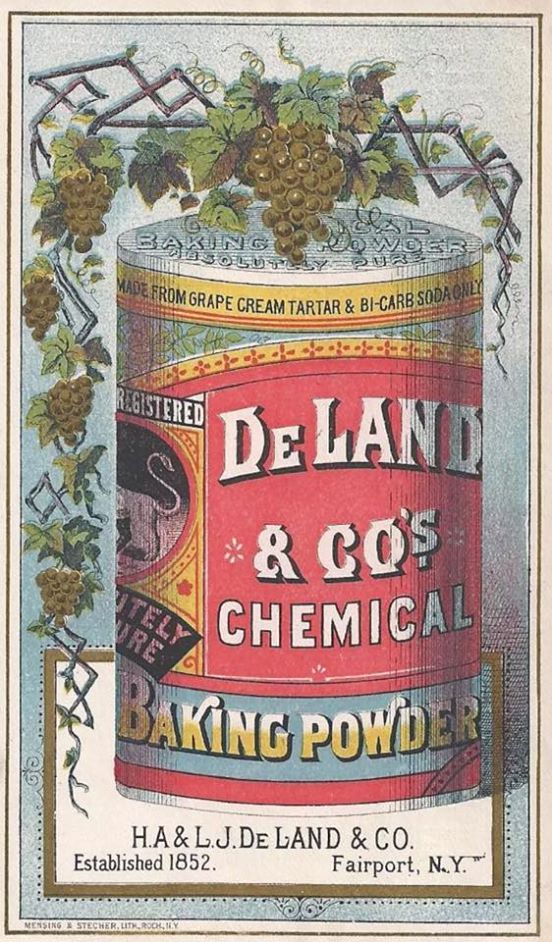
"Chemical Baking Powder" by Unknown - Collection of Lynn Purvis. Licensed under Public Domain via Commons - https://commons.wikimedia.org/wiki/File:Chemical_Baking_Powder.jpg#/media/File:Chemical_Baking_Powder.jpg
Until the the invention of baking powder eggs were the only thing that made cakes rise.  The active ingredients in baking powder are a mix of bicarbonate of soda and cream of tartar.  Cream of Tartar is an acid - potassium hydrogen tartarate (KC4H5O6). Bicarbonate of Soda is an alkali - Sodium Hydrogen Carbonate (NaHCO3).  When these two chemicals are mixed in a liquid there is a chemical reaction which produces carbon dioxide gas amongst other  things (NaHCO3 + KHC4H4O6 → KNaC4H4O6 + H2O + CO2). The carbon dioxide gas gets trapped in the cake mixture and as the cake is cooked the gas expands, making the cake rise.


Norfolk Vinegar cake rises using the same principle as baking powder.  The acidic vinegar in the cake replaces the acidic cream of tartar in baking powder and reacts with the bicarbonate of soda that is also in the ingredient list to produce the carbon dioxide that makes the cake rise.


Felt a bit odd adding vinegar to cake mix

Frothing of Vinegar + Bicarb=Carbon Dioxide

Mr Vitty was rather skeptical about the use of vinegar in cake, but the resulting cake was quite nice.  The texture of the cake mix was less runny than a normal cake mix and the final result was a cake with a texture similar to that of a rock cake.  It was also quite sweet - perhaps in an attempt to mask any residual vinegar taste.  If I make it again I think I'll add some grated apple to moisten it a little and some cinnamon, nutmeg or all spice to give it a bit of a more interesting flavour.  This could also be easily adapted to a dairy free vegan cake by replacing the milk with soy or almond milk and substituting the butter for a dairy free alternative.  Theoretically I guess you could substitute the vinegar for anything acidic - orange juice perhaps?  It's good for when you get that cake craving but can be bothered to go out and get eggs.


Ingredients:


225g Butter
450g Self Raising Flour
225g Caster Sugar
450g Dried Fruit
180ml Milk + 1 Tablespoon
2 Tablespoons Cider Vinegar
1 Teaspoon Bicarbonate of Soda

Method:


Rub the butter into the flour until it resembles breadcrumbs and then mix in the sugar and dried fruit.  In a large jug mix together 180ml of milk and the vinegar.  Mix the bicarbonate of soda with the remaining tablespoon of milk and add to the milk/vinegar mixture.  Mix the foaming milk into the dry ingredients and quickly place in a 23cm round baking tin.  Cook at 180 C for 30 minutes and then turn down the oven to 160 C continuing to cook for about an hour or until a knife placed into the cake comes out clean.

Sunday, 24 January 2016

Bread Pudding

Bread Pudding is one of the things I remember from my childhood as something my grandmother used to cook.  It's the first recipe in an old diary I use to write down recipes I've picked up from family and friends.  Mr Vitty used to have a saturday job in a bakery when he was much younger and said they used to make it from left over bread that had sat outside in the yard for a few days (with the predictable vermin/bird activity).  Mine didn't quite go through that 'maturation' process but I like that it makes use of left over bread (although I don't generally have much of that), reflecting the thriftyness of the past which we don't seem to value any more. 


Ingredients:

Large loaf of bread
500g Dried Mixed Fruit
225g Brown Sugar
1.5 Teaspoons Mixed Spice
125g Suet
125g Butter chopped into small pieces
1 Egg

Ready for the Oven


Method:

Soak the bread in cold water for 15 minutes.  Squeeze out the excess water and then mix in the fruit, brown sugar, mixed spice, suet, most of the butter and the egg. Place in a roasting tin and fleck with the remaining butter.  Cook at 180 C for 11/4 to 11/2  hours.  Remove from the oven and dredge with caster sugar.  Eat warm or cold.

Ready to Eat

Sunday, 17 January 2016

Gardeners Chicken


My new year resolution to shop more locally got off to a good start as I investigated our nearest butchers - 3.6 miles away in Swanton Morley (local is a relative term in this bit of Norfolk).  As far as possible their meat is produced in the county. It's a really friendly shop which has a little deli at the back.  I bought a lovely chicken from them which formed the basis of Gardeners Chicken one of the January recipes in the 1974 cookery year.  Mr Vitty really didn't like this recipe (although I thought it was quite nice).  Its a chicken casserole with potatoes, turnips (which I couldn't get so substiuted with swede) and bacon.  The chicken is cooked on the bone which meant that Mr Vitty had to dissect his food, something he hates doing - no matter how good it tastes.


The flavours of this stew were quite simple and classic, with few herbs or spices compared with a modern equivalent. The sauce was also quite thin.  I'd happily eat it again, but I don't think Mr Vitty will.


Ingredients:

1 Chicken jointed into portions
50g Streaky Bacon with the rind cut off and diced
2 large onions thinly sliced
2 sticks celery diced
125g Mushrooms
50g Unsalted Butter
500g New Potatoes
250g Turnips or Swede diced
Tin of Tomatoes
Bouquet Garni (I used Bay, Thyme and Rosemary)
Salt and Pepper
Parsley
Orange Rind

Method:

In a large casserole dish brown the chicken and bacon in the butter.  Remove from the pan and soften the onions, celery and mushrooms in the remaining juices.  Place the chicken on the bed of vegetables and add the potatoes and diced turnips.  Tip in the tin of tomatoes and season with salt and pepper and the bouquet garni.  Seal the casserole with tin foil to prevent any steam escaping and put the lid on the casserole dish.  Cook in a pre heated oven at 150 C for about an hour and a half or until the chicken is well cooked and falling off the bone.  Before serving sprinkle over the parsley and finely grated rind of half an orange. 

I took the leftovers for lunch at work and just took the chicken off the bone so it was easy to microwave.


Saturday, 9 January 2016

Crepes Suzette 1974

Over Christmas we were lucky enough to be cooked for by our families, so for New Year we decided to have a nice meal with just the two of us.  I rarely cook game so took the opportunity to try a main course of pheasant with boulanger potatoes and cavolo nero with bacon and chestnuts.  That was preceeded by smoked salmon blinis - one of Mr Vitty's favourites.

Pudding provided the ideal opportunity to get one of my food year resolutions underway with a recipe from the 1974 cookery year - Crepes Suzette.

A '70s Classic


This classic dish of pancakes in a caramelised orange sauce is something I'd never attempted before (or even eaten), but went well after the richness of the pheasant.  Unusually the 1974 recipe called for baking powder to be added to the pancake batter which made them slightly spongy, something I don't think I'll be doing in the future.  The sauce could have been a little more caramelised but the sweet, orangey, slightly alcoholic juice soaked into the pancakes. I'd forgotten to buy the lemons needed to make the sauce slightly sharper, but the creme fraiche helped balance the sugariness.

Pancakes, butter, oranges, alcohol

Pancakes soaking up the buttery, orangey juices

Crepes Suzette
 
100g Plain Flour
2 Eggs
300 ml Milk
Pinch of Salt
50 g Sugar
Juice of 2 oranges
Juice of half a lemon
2-4 Tablespoons of Grand Marnier
25 g Butter

Make the pancakes by whisking together the flour, salt, eggs and milk into a smooth batter.  Allow to stand for 30 minutes or leave in the fridge until you need it.  Cook the pancakes in a large frying pan with a little butter and layer with greaseproof paper to prevent them sticking together.

Put the sugar in a large frying pan over a low-medium heat and leave to caramelise, resisting the temptation to stir the sugar until it begins to melt at the edges.  When the sugar is golden brown stir in the orange and lemon juice.  Allow to reduce a little and then add the Grand Marnier.  Burn off the alcohol.  Add the butter in small lumps and allow the sauce to thicken slightly. Fold the pancakes into quarters and put them in the pan in the syrup, turning them over so they are coated in they syrupy sauce.  Add some orange segments and allow the pancakes to warm through before serving with creme fraice or cream.

Saturday, 2 January 2016

New Year Food Resolutions

Its the time of year for making changes (or at least resolving to).  I'm terrible at keeping New Year Resolutions and therefore tend to make the same ones annually!  The annual food related resolutions are:

1. Shop more locally

2. Eat more seasonally

3. Diversify the meals we eat (we tend to get stuck in a rut)

 (and lose weight of course)


I live in rural Norfolk a region of the UK which is dependent on the agrifood industry for much of its economic growth.  The land I drive through every day on my way to work produces fruit, vegetables, poultry, pigs, dairy products (as well as vegetable oil, sugar and bootiful turkey).  Norfolk also as one of the longest coast lines in the country with the associated remnants of a fishing industry.  Good farm shops are around but it takes more effort to visit them than doing my weekly on-line sainsburys order.  Yet having vegetables grown in Peru which have been flown half way around the world so I can eat strawberries in December is bad for the planet and doesn't help me diversify the foods I eat.  I know I'll never be able to only eat food produced/sold locally (I'm not imaginative or disciplined enough), but I plan to increase the amount of locally produced food we eat to reduce the food miles and help the survival of our local small businesses.  Some of the regional food producers are the best in the world at what they make and with a bit of extra effort I can make sure we make the most of the skill and abundance of the people and land around me.


To help in both the seasonality of our eating and in diversifying what we eat I'm planning to cook one recipe each week from my 1974 copy of the Cookery Year.  The book was a wedding present for my parents and published the year I was born.  I 'borrowed' it in 1994 when I went to University and last year one of my colleagues rebound it for me in return for me teaching her how to cook profiteroles (which I still haven't done).

Like some of Nigel Slaters books (which I love) The Cookery Year gives recipies for each month with ingredients that are in season.  It also explains what to look for in terms of quality of ingredients and uses what to us now are unusual cuts of meat.  The quanity of double cream used in some of the recipes is a little alarming, but I'm sure we'll cope.


Wednesday, 30 December 2015

Bringing Christmas

Food is such an important part of what makes christmas special in my family.  Sitting round a table with friends and family enjoying prawn cocktail, turkey, pigs in blankets and invariably overcooked sprouts. My sister used to say that I used to bring Christmas with me when I arrived home on Christmas Eve.  That was because I usually arrive with the Christmas Cake, Christmas Pudding, Mince Pies and (her favourite) Delia's Chocolate Log.  This year was no different, so even though my Uncle was cooking the main event we filled the car with ‘Christmas’ as we drove down to Kent.


This year's cake dispensed with the normal marzipan and royal icing.  The glazed fruit topping was quite effective and healthier than the 'normal' - although Mr Vitty missed his sugar rush


Chocolate log


Stollen for my Mum


Changing Christmas food traditions at christmas can be difficult -so changing the chocolate log recipe from Delia’s to Will Torrent’s from his Chocolate at Home Book was quite a risk.  I chose this recipe because it included a french meringue buttercream which I wanted to try and make.  It involves making a french meringue and then enriching it with butter and flavourings. It was quite straight forward and Mr Vitty said the buttercream tasted like Sara Lee Chocolate Gateaux - which I guess is a compliment ?!

Chocolate Cake Base


Meringue Butter Cream

Probably the strangest thing I've done with a cake - but it was subsequenly easy to roll

Ready for covering


As well as the chocolate log I made the Christmas Cake, Mince Pies and Christmas pudding.  I have made mincemeat in the past but generally find that enhancing the shop bought stuff serves just as well.  I therefore added some hazelnuts, flaked almonds, fresh orange juice and zest and a good slug of brandy to some quite basic mincemeat and made them up into mince pies with a mishmash of puff and shortcrust pastry and crème amande that I found lurking in the freezer.  The crème amande ones went down particularly well with my father-in-law.

The crème amande was left over from what has become a more recent christmas tradition - a gift of stollen for my Mum and work colleagues. The recipe I use is from Richard Bertinet's book Crust. It's less sweet than much of the shop bought stollen, freezes well and tastes really good.

Enriched Bread Dough

Fruit and nuts ready to be incorporated into the dough
Dough, creme amande and marzipan for the filling

Proved and ready for the oven
Baked and ready for eating


Christmas baking over for another year it's now just eating up the left overs and planning the New Year's diet and fitness kick.


Tuesday, 29 December 2015

Christmas Presents


Tablet and Coconut ice


I normally really like Christmas.  The lights, food, presents (and sometimes even being with family).  Its a time of year where I spend lots of time thinking about others – what do they want for Christmas? Should I give my diabetic Dad sweets he likes even though they’ll eventually kill him? How are we going to get to Kent/Cumbria/Back home as quickly as possible? and of course what are we going to eat on the way.
But this year it all got a bit much.  At the risk of sounding curmudgeonly I found myself wondering why I was shopping for Christmas presents for people who pretty much could have bought things themselves if they wanted them.  So partly to dispel the spirit of Scrooge I decided to put in time as well as money and made some presents for my family.
 
The real inspiration was my Nanny.  She’s 93 and in her younger days she was a dinner lady and great cook. I particularly remember her cakes and puddings – suet based of course, and very traditionally British.  At 93 there are various things she can’t eat but she loves coconut ice and fudge (both of which require condensed milk which kept Mr Vitty happily scraping out the residue of the tin).  They also sparked a fit of Christmas nostalga and became 'leftovers' for those family who 'don't do presents'.


Coconut Ice isn’t really cooking – more just mixing stuff together.  I used the Carnation Coconut Ice Recipe.  I made the traditional pink and white version but also made some chocolate by mixing in about 50g of melted dark chocolate to ¼ of the mixture.  I haven’t had coconut ice for years and it was a real taste of my childhood.  The most difficult thing about it was getting the mixture level in the tin (I failed miserably - do cooks spirit levels exist?)  Although I enjoyed it the texture wasn’t quite right, I think mainly due to the size of the dessicated coconut.  If I make it again I think I’ll either by shorter strands of coconut or blitz it slightly in my little chopping machine to make it a little smaller
 
The fudge was a Scottish Tablet recipe. Like many Scottish versions of sweets it’s fudge with bells on.  The texture of tablet is more crystalline than English fudge – probably due to the large amount of sugar that also makes it tooth achingly sweet.  I used a recipe that’s written in an old diary from 1994 that I scribbled down various recipes from friends, family, magazines etc.  This recipe dates from the time I spent at University in Edinburgh and brought back memories of good friends and battered mars bars.

Tablet Recipe

7oz Condensed Milk
1 Tablespoon Butter
2 lb Sugar
1 Cup Milk

Put all the ingredients in a large saucepan and bring slowly to the boil allowing the sugar to completely dissolve. Boil slowly until the mixture caramelises and reaches the soft ball stage.  Remove the pan from the heat and beat until the mixture begins to crystalise at the edges.  Pour into a buttered tin and allow to cool.

Although I've always made this without additional flavouring I think adding some stem ginger, vanilla or perhaps dried cranberries just before putting it in the tin could be nice.