I love hazelnut and chocolate so when my work colleague presented me with a 'Ready, Steady Cook' challenge to make something from a left packet of toasted hazelnuts cookies immediately sprang to mind.
The base of the recipe was Will Torrent's Macadamia and caramelised white chocolate cookies from Chocolate at Home, but I replaced the macadamia nuts with the hazlenuts and white chocolate with 70% dark. The result were some really nice, not over sweet cookies (if a little crunchier than I would have liked).
Ingredients:
175 g Unsalted Butter
175 g Soft Light Brown Sugar
75 g Caster Sugar
2 Eggs Beaten
1 Teaspoon Vanilla Extract
250 g Plain Flour
1/2 Teaspoon Bicarbonate of Soda
100 g Toasted Hazelnuts
150 g Dark Chocolate Chips
Method:
Melt the butter in a small pan and heat for 5-10 minutes until it is golden brown and smells nutty. Let the butter cool to room temperature.
Add the sugars to the butter and beat until pale and light. Add the egg and the vanilla extract.
Sift together the flour, salt and bicarbonate of soda and mix in the hazelnuts and chocolate chips. Mix with the butter and sugar into a soft dough. Spoon the mix onto a sheet of clingfilm and roll into a sausage with a diameter of about 7cm. Chill the dough for at least an hour.
Preheat the oven to 180 oC. Slice the dough into discs about 1 cm wide and place on baking sheets lined with greaseproof paper leaving plenty of space between them so they can spread. Bake for 10-12 minutes or until the edges of the cookies are golden brown but the centre is still soft. Leave to firm up on the baking tray for a few minutes before cooling on a wire rack.
This is my personal musings on what I cook, eat and some of the food science behind the recipes and headlines. You can also follow this blog on facebook at https://www.facebook.com/Vittyfood or twitter @vittydanino
Wednesday, 20 July 2016
Wednesday, 1 June 2016
A Sweet Avocado Fool - As weird as it sounds
We've been eating alot of avocado recently as we've been bingeing on chicken fajitas as part of an endeavour to reduce our red meat consumption. It makes an appearance in the guacamole and goes well with lime.
Lime also goes well with dairy and sugar (think cheesecake). But avocado, lime, cream and sugar??? An avocado fool was described in my 1974 Cookery Year as 'refreshing'. Mr Vitty's adjective was less complimentary ('vile').
We'll stick to avocado in guacamole or paired with prawn cocktail for the 70's twist.
Lime also goes well with dairy and sugar (think cheesecake). But avocado, lime, cream and sugar??? An avocado fool was described in my 1974 Cookery Year as 'refreshing'. Mr Vitty's adjective was less complimentary ('vile').
We'll stick to avocado in guacamole or paired with prawn cocktail for the 70's twist.
Monday, 16 May 2016
A Rhubarb, Yoghurt and Pistachio Entremet - My own invention!
Prissy little gateauxs with their requirement for precision cutting, icing and filling aren't my normal style (primarily because I turn them into a mess) but time over a bank holiday, a couple of patisserie books and watching too much of BBC's bakeoff creme de la creme prompted me to have a go.
Rhubarb had appeared in the farm shop again and I couldn't resist it's alluring red and the promise of a sharp fruit layer in my cake. For some reason a yoghurt mousse and pistachio sponge seemed like it would be a great contrast to the rhubarb. It was also a good excuse to buy yet more moulds - rectangular ones this time. Mr Vitty was a bit skeptical about including a rhubarb jelly so we adapted it into a rhubarb mousse. I've been wanting to play with some sugar work for a while now so took the opportunity to use the pistachios bought for the joconde sponge to make a pistachio brittle which provided the contrast of some much needed crunch against the softness of sponge and mousse.
We ended up with layers of pistachio joconde sponge, rhubarb mousse, yoghurt mousse, decorated with rhubarb compote, pistachios and pistachio brittle. The yoghurt mousse was probably the most surprisingly successful element, a sharp,sweet, creamy mousse. I was really pleased everything held its shape and it all came out of the moulds (with a bit of help with a blow torch). There is a lot of preparation for these and it was a great way to learn and practice a variety of techniques.
I think if I do this again I'll revert to the rhubarb jelly idea as although both mousses tasted great there wasn't enough contrast in texture and a strongly flavoured, sharp, soft set rhubarb jelly will set things off really well.
The recipes were based on those in Perfecting Patisserie by Tim Kinnaird (a local celebrity since winning Master Chef a few years ago). It's a great book which describes all the core techniques with some recipes, but encourages inventiveness and playing with your own flavours and textures.
Pistachio Joconde Sponge
100 g Caster Sugar
40 g Egg Yolks
40 g Ground Pistachio
50 g Plain Flour
70 g Egg White
Whisk together half the caster sugar and egg yolks until pale and fluffy. Fold in the nuts and plain flour. Whisk the egg whites for 30 seconds and then add the rest of the sugar. Continue to whisk until the mixture forms soft peaks of meringue. Mix 1/3 of the meringue into the pistachio mixture to slacken it and then gently fold in the rest of the meringue. Spread onto a lined baking tray and bake for 10-12 minutes at 170 oC until lightly browned and springy. Leave to cool
Rhubarb Puree
250 g Rhubarb
1 tablespoon water
60 g Caster sugar
Chop the Rhubarb into short lengths and simmer with a little water and caster sugar until soft. Blitz in a food processor or blender and pass through a sieve. As this was to be added to meringue to form the mousse I only added half the sugar to try and prevent everything becoming too sweet
Italian Meringue
100 g Egg Whites
300 g Caster Sugar
70 g Water
Heat the sugar and water in a small saucepan until it reaches a temperature of 117 oC. As the sugar and water mixture is coming up to temperature begin to whisk the egg whites in a stand mixer. Whilst whisking, pour the hot sugar syrup into the egg whites in a thin stream. Continue to whisk until the mixture is stiff and cool.
The Mousses (makes far to much for the quantity of sponge - but still got eaten)
1 quantity Italian Meringue split into 2
150 g Rhubarb Puree / Plain Yoghurt
300 g Whipping Cream whipped to soft peaks and split into 2
2 x 5 g Silver Leaf Gelatine (or equivalent)
Soak each 5 g quantity of gelatine in separate bowls of water. Warm the yoghurt and rhubarb puree in separate saucepans and add one quantity of soaked gelatine to each and allow to cool. To one half of the meringue fold in the rhubarb puree and to the other half of the meringue fold in the yoghurt. Then fold half the cream into each flavoured meringue.
Pistachio Brittle
Caster Sugar
Pistachios
Place the pistachios in a food bag and bash with a rolling pin to break them into smaller pieces. Heat caster sugar in a small saucepan over a medium heat and stir periodically until the sugar has melted and is a light brown colour. Remove from the heat and quickly add the nuts and then pour onto a silicone mat. Allow to cool before breaking into decorative shards or place in a food bag and bash with a rolling pin for a crunchy topping.
Assembly
Use a metal mould to cut out the right shapes from the sponge. You'll need twice as many cut pieces as final portions.
Leave the moulds around half the sponge pieces and pipe in a layer of rhubarb mousse. Place another layer of sponge ontop then pipe on a layer of yoghurt mousse.
Place the moulds in the fridge for at least an hour to allow the mousses to firm up so the cakes hold their shape. Remove the cakes from the fridge and heat the metal with a blow torch to allow it to expand slightly so you can easily remove the mould. Be careful not to melt the mousses too much.
Place the unmoulded cakes back into the fridge to firm back up again.
You can then decorate them as you like. For some of mine I brushed the cakes with a little reserved rhubarb puree which acted as glue for some crushed pistachios. For others I left the cakes naked so I could see the layers and sprinkled the tops with some crushed brittle.
Rhubarb had appeared in the farm shop again and I couldn't resist it's alluring red and the promise of a sharp fruit layer in my cake. For some reason a yoghurt mousse and pistachio sponge seemed like it would be a great contrast to the rhubarb. It was also a good excuse to buy yet more moulds - rectangular ones this time. Mr Vitty was a bit skeptical about including a rhubarb jelly so we adapted it into a rhubarb mousse. I've been wanting to play with some sugar work for a while now so took the opportunity to use the pistachios bought for the joconde sponge to make a pistachio brittle which provided the contrast of some much needed crunch against the softness of sponge and mousse.
We ended up with layers of pistachio joconde sponge, rhubarb mousse, yoghurt mousse, decorated with rhubarb compote, pistachios and pistachio brittle. The yoghurt mousse was probably the most surprisingly successful element, a sharp,sweet, creamy mousse. I was really pleased everything held its shape and it all came out of the moulds (with a bit of help with a blow torch). There is a lot of preparation for these and it was a great way to learn and practice a variety of techniques.
I think if I do this again I'll revert to the rhubarb jelly idea as although both mousses tasted great there wasn't enough contrast in texture and a strongly flavoured, sharp, soft set rhubarb jelly will set things off really well.
The recipes were based on those in Perfecting Patisserie by Tim Kinnaird (a local celebrity since winning Master Chef a few years ago). It's a great book which describes all the core techniques with some recipes, but encourages inventiveness and playing with your own flavours and textures.
![]() |
| All the bits ready to go |
Pistachio Joconde Sponge
100 g Caster Sugar
40 g Egg Yolks
40 g Ground Pistachio
50 g Plain Flour
70 g Egg White
Whisk together half the caster sugar and egg yolks until pale and fluffy. Fold in the nuts and plain flour. Whisk the egg whites for 30 seconds and then add the rest of the sugar. Continue to whisk until the mixture forms soft peaks of meringue. Mix 1/3 of the meringue into the pistachio mixture to slacken it and then gently fold in the rest of the meringue. Spread onto a lined baking tray and bake for 10-12 minutes at 170 oC until lightly browned and springy. Leave to cool
Rhubarb Puree
250 g Rhubarb
1 tablespoon water
60 g Caster sugar
Chop the Rhubarb into short lengths and simmer with a little water and caster sugar until soft. Blitz in a food processor or blender and pass through a sieve. As this was to be added to meringue to form the mousse I only added half the sugar to try and prevent everything becoming too sweet
Italian Meringue
100 g Egg Whites
300 g Caster Sugar
70 g Water
Heat the sugar and water in a small saucepan until it reaches a temperature of 117 oC. As the sugar and water mixture is coming up to temperature begin to whisk the egg whites in a stand mixer. Whilst whisking, pour the hot sugar syrup into the egg whites in a thin stream. Continue to whisk until the mixture is stiff and cool.
The Mousses (makes far to much for the quantity of sponge - but still got eaten)
1 quantity Italian Meringue split into 2
150 g Rhubarb Puree / Plain Yoghurt
300 g Whipping Cream whipped to soft peaks and split into 2
2 x 5 g Silver Leaf Gelatine (or equivalent)
Soak each 5 g quantity of gelatine in separate bowls of water. Warm the yoghurt and rhubarb puree in separate saucepans and add one quantity of soaked gelatine to each and allow to cool. To one half of the meringue fold in the rhubarb puree and to the other half of the meringue fold in the yoghurt. Then fold half the cream into each flavoured meringue.
Pistachio Brittle
Caster Sugar
Pistachios
Place the pistachios in a food bag and bash with a rolling pin to break them into smaller pieces. Heat caster sugar in a small saucepan over a medium heat and stir periodically until the sugar has melted and is a light brown colour. Remove from the heat and quickly add the nuts and then pour onto a silicone mat. Allow to cool before breaking into decorative shards or place in a food bag and bash with a rolling pin for a crunchy topping.
Assembly
Use a metal mould to cut out the right shapes from the sponge. You'll need twice as many cut pieces as final portions.
Leave the moulds around half the sponge pieces and pipe in a layer of rhubarb mousse. Place another layer of sponge ontop then pipe on a layer of yoghurt mousse.
Place the moulds in the fridge for at least an hour to allow the mousses to firm up so the cakes hold their shape. Remove the cakes from the fridge and heat the metal with a blow torch to allow it to expand slightly so you can easily remove the mould. Be careful not to melt the mousses too much.
Place the unmoulded cakes back into the fridge to firm back up again.
You can then decorate them as you like. For some of mine I brushed the cakes with a little reserved rhubarb puree which acted as glue for some crushed pistachios. For others I left the cakes naked so I could see the layers and sprinkled the tops with some crushed brittle.
Saturday, 9 April 2016
Hot Cross Buns
I love the seasonalityof food. The different fruit and veg at different times of year, but also the recipies and styles of cooking that fit each season; blackberry and apple crumble seems to fit the mellow fruitfulness of October whilst the red fruit infused bread of a summer pudding with the contrast of clotted cream somehow belongs in August.
That love of seasonality also extends to the food associated with the various festivals throughout the year and particularly Christmas and Easter. Although we start eating shop bought hot cross buns pretty much as soon as they appear on my on-line shopping list (i.e. Boxing day) I save making the real things until Good Friday.
Like many traditions the making of spiced buns at Easter seems to be something Christians have adopted from pagan rituals.
''The mark is of ancient origin, connected with religious offerings of bread, which replaced earlier, less civilized offerings of blood. The Egyptians offered small round cakes, marked with a representation of the horns of an ox, to the goddess of the moon. The Greeks and Romans had similar practices and the Saxons ate buns marked with a cross in honor of the goddess of light, Eostre, whose name was transferred to Easter.''---Oxford Companion to Food, Alan Davidson [Oxford University Press:Oxford] 1999 (p. 114)
Whatever their origin they have become firmly adopted as a christian representation of Christs death on the cross and resurrection. I love them. The bready-ness, sweet fruit and warming spices of nutmeg and cinnamon. They are great warm from the oven or toasted with a slick of butter.
The recipe I use is the one from River Cottage although I tend to stick to the traditional spices and fruit. I also make a thicker flour and water paste for a more defined cross on the top. They taste great and freeze well (although Mr Vitty prefers the shop bought ones...)
That love of seasonality also extends to the food associated with the various festivals throughout the year and particularly Christmas and Easter. Although we start eating shop bought hot cross buns pretty much as soon as they appear on my on-line shopping list (i.e. Boxing day) I save making the real things until Good Friday.
Like many traditions the making of spiced buns at Easter seems to be something Christians have adopted from pagan rituals.
''The mark is of ancient origin, connected with religious offerings of bread, which replaced earlier, less civilized offerings of blood. The Egyptians offered small round cakes, marked with a representation of the horns of an ox, to the goddess of the moon. The Greeks and Romans had similar practices and the Saxons ate buns marked with a cross in honor of the goddess of light, Eostre, whose name was transferred to Easter.''---Oxford Companion to Food, Alan Davidson [Oxford University Press:Oxford] 1999 (p. 114)
Whatever their origin they have become firmly adopted as a christian representation of Christs death on the cross and resurrection. I love them. The bready-ness, sweet fruit and warming spices of nutmeg and cinnamon. They are great warm from the oven or toasted with a slick of butter.
The recipe I use is the one from River Cottage although I tend to stick to the traditional spices and fruit. I also make a thicker flour and water paste for a more defined cross on the top. They taste great and freeze well (although Mr Vitty prefers the shop bought ones...)
Tuesday, 5 April 2016
A 70's Inspired Dinner Party
When my friend Sue offered to rebind my 1974 Cookery Year the price was for me to teach her to make profiteroles. I finally got round to paying my debt and Sue and her husband came round for dinner with Sue making pudding. Profiteroles (a 70s classic) comprised the pudding and it seemed appropriate that the rest of the meal came from the same era.
Menu:
Canapes: Cheese and Pineapple hedgehog; Prawn Cocktail and Guacamole Tartlets
Starter: Cheese Fondue with ciabatta (invented in 1976 apparently)
Main Course: Salmon en Croute
Dessert: Profiteroles
Petit Fours: Mini Madeleines
The menu was more about fun than haute cuisine and we had a great evening
Having promised profiterole excellence I was very relieved that they worked and as one of Mr Vitty's favourite desserts there were never going to be enough of them. Sue went home saying she was no longer apprehensive about making them in the future, so objective achieved : ) .
I also realised how much I enjoy making puff pastry which I did for the salmon en croute. I've made puff pastry before but for the first time I appreciated the therapeutic nature of the repetitive folding and rolling to make the layers and a huge sense of satisfaction when it works. I know that the all butter chilled versions you can buy from the shops are good (and I have an emergency packet in the freezer), but if I have the time I'm always going to make it in the future.
Other elements of the meal could have been better. Cheese fondue is more difficult than it looks and we didn't like it enough to bother trying to make it again (it's also not good for my cholesterol level!). I was never going to like the cheese and pineapple hedgehog, but we couldn't do without one for a 70's inspired meal.
Menu:
Canapes: Cheese and Pineapple hedgehog; Prawn Cocktail and Guacamole Tartlets
Starter: Cheese Fondue with ciabatta (invented in 1976 apparently)
Main Course: Salmon en Croute
Dessert: Profiteroles
Petit Fours: Mini Madeleines
The menu was more about fun than haute cuisine and we had a great evening
Having promised profiterole excellence I was very relieved that they worked and as one of Mr Vitty's favourite desserts there were never going to be enough of them. Sue went home saying she was no longer apprehensive about making them in the future, so objective achieved : ) .
I also realised how much I enjoy making puff pastry which I did for the salmon en croute. I've made puff pastry before but for the first time I appreciated the therapeutic nature of the repetitive folding and rolling to make the layers and a huge sense of satisfaction when it works. I know that the all butter chilled versions you can buy from the shops are good (and I have an emergency packet in the freezer), but if I have the time I'm always going to make it in the future.
Other elements of the meal could have been better. Cheese fondue is more difficult than it looks and we didn't like it enough to bother trying to make it again (it's also not good for my cholesterol level!). I was never going to like the cheese and pineapple hedgehog, but we couldn't do without one for a 70's inspired meal.
Sunday, 13 March 2016
Rhubarb and Almond Tart - inspired by left-overs
I love rhubarb (I may have said this before!). Its flavour, colour and sharp acidity that cuts through all the sweetness that we tend to surround it with. Despite often treating it like a fruit by adding lots of sugar its a vegetable - the stem of the Rheum plant that joins the leaves to the stalk.
I think of rhubarb as a staple of british cooking, the basis of comfort food of my childhood - rhubarb and apple crumble with lots of custart (out of a packet of course). But rhubarb wasn't recorded as a food crop in Europe until the 18th Century after Marco Polo brought it back from his adventures in south east asia where the roots were used in chinese medicine (particularly for its laxative properties....). Even in the UK it was first grown as a medicine from seeds imported from Russia. Its first recorded use as a food in britain was in an1806-7 cookbook by Maria Eliza Rundell where it was used in a rhubarb tart. My favourite uses for it also include a cinnamon and rhubarb tart where the filling is completed with double cream, a little flour and sugar, rhubarb polenta cake where the cornmeal soaks up the ruby red juices of the rhubarb and (of course) rhubarb and apple crumble.
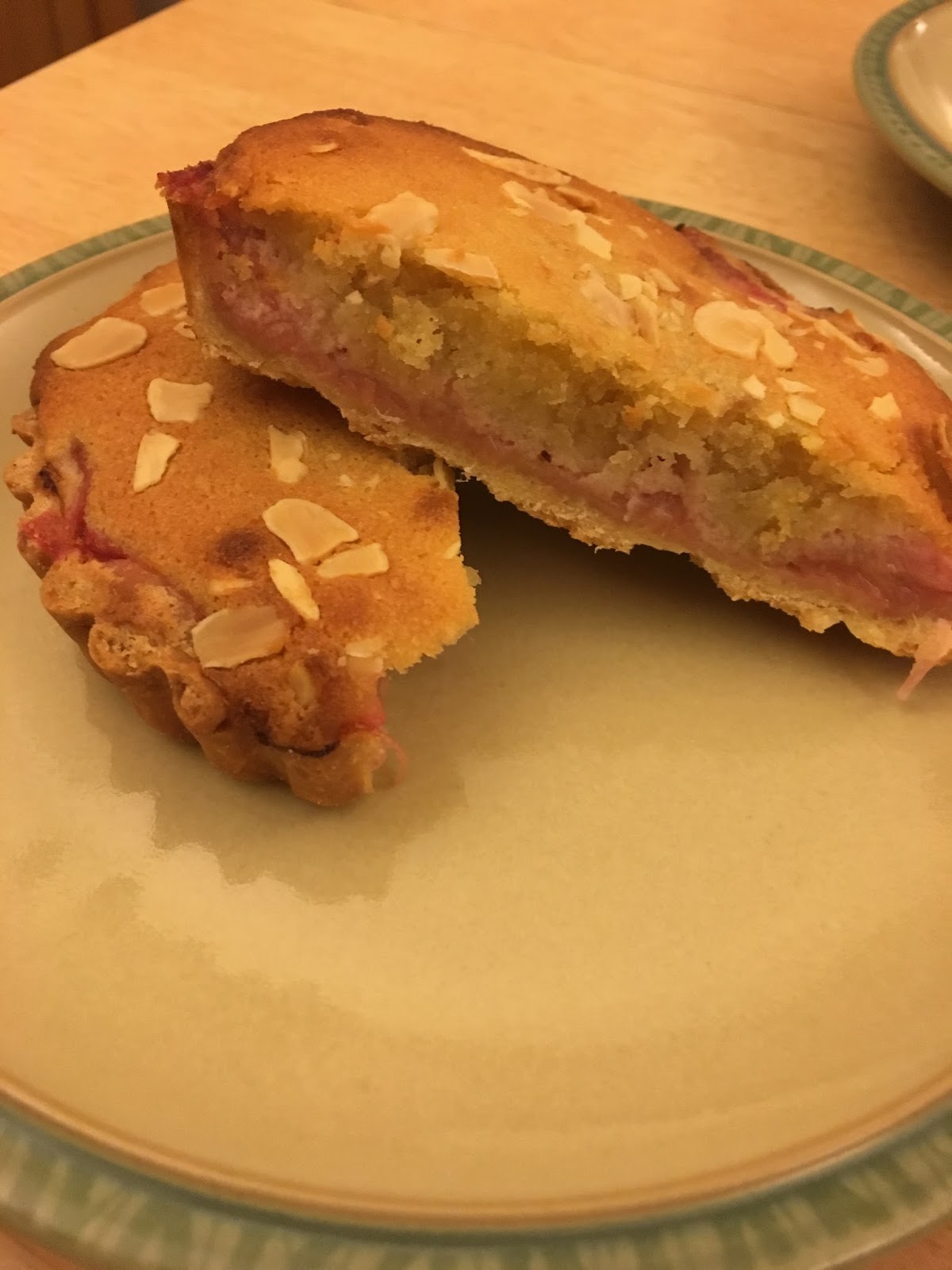
When I couldn't resist the bright pink stems in the local farm shop one Saturday morning I wanted to do more with them than stew them and eat them with yoghurt and honey (although that's not a bad way to eat it either). I had some sweet pastry and creme almond lurking in the freezer from before christmas which provided the inspiration for a rhubarb and almond tart. Given it was completely made up I was really pleased with the outcome. The sharpness of the Rhubarb cut through the sweetness of the almond paste and pastry, yet we could still taste all the different parts (and no soggy bottoms).
To make these line some small tart tins with the sweet pastry and blind bake them at 200 C to make sure they're crisp. As they came out of the oven remove the lining paper and baking beans and brush with beaten egg and put them back in the oven for a couple for a couple of minutes. Stew the ruhubarb and reduce down to a thick paste. Add as little sugar as you can to make it palatable (the contrast between the sharpness of the rhubarb and sweetness of the almond paste is the joy of this tart) and put it in the bottom of the sweet pastry case. Top with the almond paste and scatter with some flaked almonds. Put the tarts back in the oven until the paste has set and browned on the top. Cool on a wire rack before removing from the tins and dusting with a little icing sugar.
I'm always surprised and delighted when somehting I invent works and these were really good (even if I do say so myself). Even Mr Vitty who isn't a great fan of either rhubarb or almond liked them. When I make them again I'll use more rhubarb to get a deeper layer and try and make the rhubarb paste thicker so it doesn't leach quite so much into the almond layer. Even so, if I bought these in a cafe to have with an afternoon cup of Earl Grey I wouldn't have been disappointed.
I think of rhubarb as a staple of british cooking, the basis of comfort food of my childhood - rhubarb and apple crumble with lots of custart (out of a packet of course). But rhubarb wasn't recorded as a food crop in Europe until the 18th Century after Marco Polo brought it back from his adventures in south east asia where the roots were used in chinese medicine (particularly for its laxative properties....). Even in the UK it was first grown as a medicine from seeds imported from Russia. Its first recorded use as a food in britain was in an1806-7 cookbook by Maria Eliza Rundell where it was used in a rhubarb tart. My favourite uses for it also include a cinnamon and rhubarb tart where the filling is completed with double cream, a little flour and sugar, rhubarb polenta cake where the cornmeal soaks up the ruby red juices of the rhubarb and (of course) rhubarb and apple crumble.
When I couldn't resist the bright pink stems in the local farm shop one Saturday morning I wanted to do more with them than stew them and eat them with yoghurt and honey (although that's not a bad way to eat it either). I had some sweet pastry and creme almond lurking in the freezer from before christmas which provided the inspiration for a rhubarb and almond tart. Given it was completely made up I was really pleased with the outcome. The sharpness of the Rhubarb cut through the sweetness of the almond paste and pastry, yet we could still taste all the different parts (and no soggy bottoms).
To make these line some small tart tins with the sweet pastry and blind bake them at 200 C to make sure they're crisp. As they came out of the oven remove the lining paper and baking beans and brush with beaten egg and put them back in the oven for a couple for a couple of minutes. Stew the ruhubarb and reduce down to a thick paste. Add as little sugar as you can to make it palatable (the contrast between the sharpness of the rhubarb and sweetness of the almond paste is the joy of this tart) and put it in the bottom of the sweet pastry case. Top with the almond paste and scatter with some flaked almonds. Put the tarts back in the oven until the paste has set and browned on the top. Cool on a wire rack before removing from the tins and dusting with a little icing sugar.
I'm always surprised and delighted when somehting I invent works and these were really good (even if I do say so myself). Even Mr Vitty who isn't a great fan of either rhubarb or almond liked them. When I make them again I'll use more rhubarb to get a deeper layer and try and make the rhubarb paste thicker so it doesn't leach quite so much into the almond layer. Even so, if I bought these in a cafe to have with an afternoon cup of Earl Grey I wouldn't have been disappointed.
Sunday, 21 February 2016
A Month of Eating 1974 Style
Since the New Year I've been trying to eat more seasonally, diversify my cooking and use my 1974 Cookery Year. British food of the 1970s doesn't have a great reputation. Indeed if you think of cookery programmes of the time the food is swimming in double cream and alcohol (think of Keith Floyd). To a certain extent the last month has reinforced those stereotypes. Our food has been quite 'brown' and the amount of cream that many of the recipes call sound like a heart attack on a plate. Mr Vitty hasn't appreciated the changes either- saying it reminds him of the food of his childhood - apparently not a good thing. January possibly isn't the best time to try and eat seasonally, so we'll plough on (but perhaps I'd have been better off cooking my way through Nigel Slater's new book - maybe next year).
What stikes me most about the recipes from 1974 is how much our food culture has changed, exemplified by the need to explain what tagliatelle was. Yet it's not only the diversity of our food that has evolved, but also how we shop, what we buy, and how we consider how food affects our health. The national food survey has been looking at the food shopping habits of the UK population since 1940 and an analysis of that data since 1974 has recently been released. This shows that we are eating less of things like white bread, liver and full fat milk replacing them with things like pasta, brown bread, skimmed milks and pizza. This may be due to the impact of food health campaigns such as the focus on saturated fat and cholesterol in the 90's as well as societal changes such as the increased reliance on convenience foods.
We are also spending a smaller proportion of our income on food. This may be due in part to the growth and pricing power of the supermarkets. It's also a reflection of intensive farming practises and a lower farm gate price that results in things like last years milk price where farmers were being paid at below the cost of production for milk. I've really enjoyed shopping more locally and buying regionally produced foods, but it is a luxury I'm glad I'm able to afford in both time and money.
What stikes me most about the recipes from 1974 is how much our food culture has changed, exemplified by the need to explain what tagliatelle was. Yet it's not only the diversity of our food that has evolved, but also how we shop, what we buy, and how we consider how food affects our health. The national food survey has been looking at the food shopping habits of the UK population since 1940 and an analysis of that data since 1974 has recently been released. This shows that we are eating less of things like white bread, liver and full fat milk replacing them with things like pasta, brown bread, skimmed milks and pizza. This may be due to the impact of food health campaigns such as the focus on saturated fat and cholesterol in the 90's as well as societal changes such as the increased reliance on convenience foods.
We are also spending a smaller proportion of our income on food. This may be due in part to the growth and pricing power of the supermarkets. It's also a reflection of intensive farming practises and a lower farm gate price that results in things like last years milk price where farmers were being paid at below the cost of production for milk. I've really enjoyed shopping more locally and buying regionally produced foods, but it is a luxury I'm glad I'm able to afford in both time and money.
Subscribe to:
Posts (Atom)